Projectdoodleshnookie.net
SubjectIndex of sheets
Sheet0
Date
By tuco86

Three Rust projects, and the log of building them with coding agents.

  1. 1

    weida

    A messaging framework for Rust, built from first principles around QUIC.

  2. 2

    iced_nodegraph

    A node graph editor widget for iced.

  3. 3

    zeughaus

    A visual dataflow workbench, built on iced and iced_nodegraph.

    • built: Built on iced_nodegraph
    • pending: Will route between runners over weida
built
partial
pending

weida

A messaging framework for Rust, built from first principles around QUIC.

What it is

Every user data flow maps to one QUIC stream, so a 40-byte transfer and a 40-GB transfer use the same protocol semantics, and neither needs the payload in memory.

It is built in layers: a stream core, the ZeroMQ/nanomsg pattern family as thin wrappers over it, and a RabbitMQ-style broker. Next to the protocol, the same foundation carries Rust client libraries for the protocols it competes with.
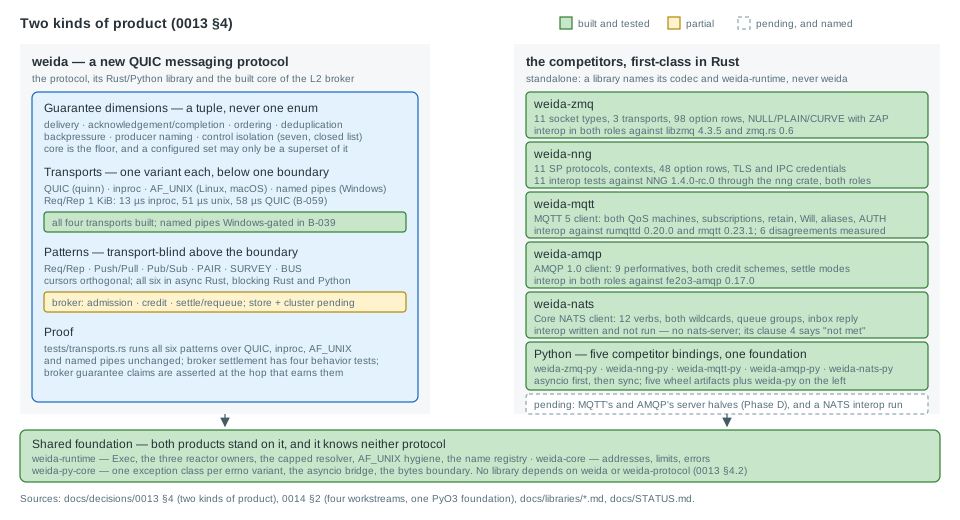
weida's product line as a diagram: on the left the QUIC protocol with its guarantee dimensions, four transports, six patterns and the broker; on the right the ZeroMQ, NNG, MQTT, AMQP and NATS client libraries; both stand on one shared foundation.
Fig. 1 weida/docs/status/product-line.svg @ 1b08f5a

State

  • built: Protocol and stream core over four transports: QUIC, inproc, AF_UNIX, Windows named pipes
  • built: All six patterns (Req/Rep, Push/Pull, Pub/Sub, PAIR, SURVEY, BUS) in async Rust, blocking Rust and Python
  • built: Client libraries for ZeroMQ, NNG, MQTT 5, AMQP 1.0 and NATS
  • partial: Broker: admission, credit and settle/requeue built; store and clustering not yet
iced_nodegraph

A node graph editor widget for iced.

What it is

Nodes are ordinary iced widgets on an infinite zoom and pan canvas, wired together through typed pins. The widget holds no graph state: the application owns the model, and connections, moves and deletes arrive as messages.

Everything on the canvas is drawn by one wgpu pipeline as signed distance fields, so it stays sharp at every zoom level and handles graphs with hundreds of nodes.

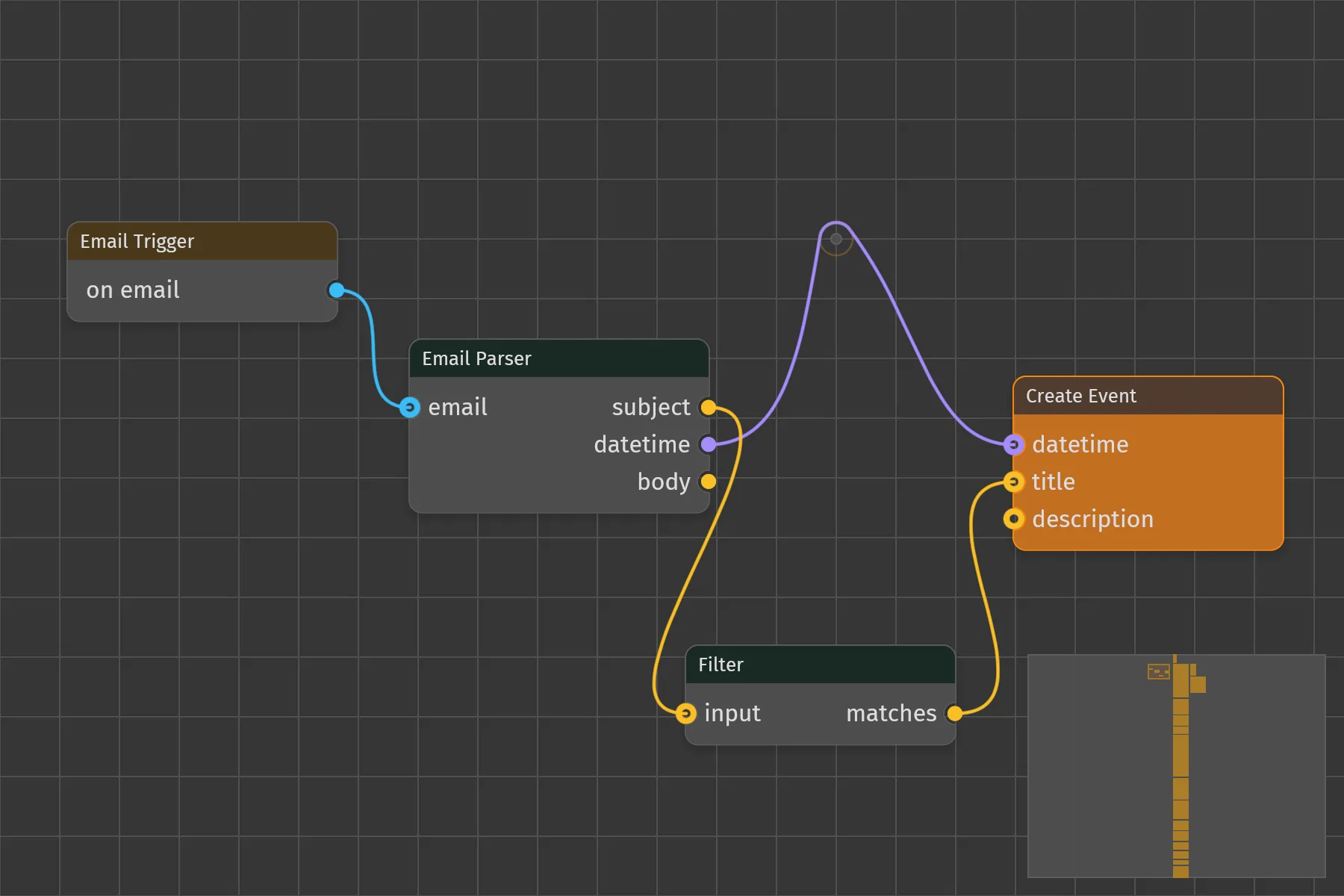
The hello_world demo: an email workflow graph with four connected nodes, Email Trigger, Email Parser, Filter and Create Event, on a grid canvas with a minimap.
Fig. 2 iced_nodegraph/assets/hero.png @ 998f6fb

State

  • built: Released as 0.5.0 on crates.io, MIT licensed, documented on docs.rs
  • built: Demos that run in the browser on WebGPU
  • partial: 0.6.0 in development

zeughaus

A visual dataflow workbench, built on iced and iced_nodegraph.

What it is

Math and string transforms, screen capture, SQLite schemas, LLM conversations, Keras model design and recordings are composed as one node graph.

The graph is edited collaboratively and executed by a headless runner, which also multiplexes terminals for its editors.

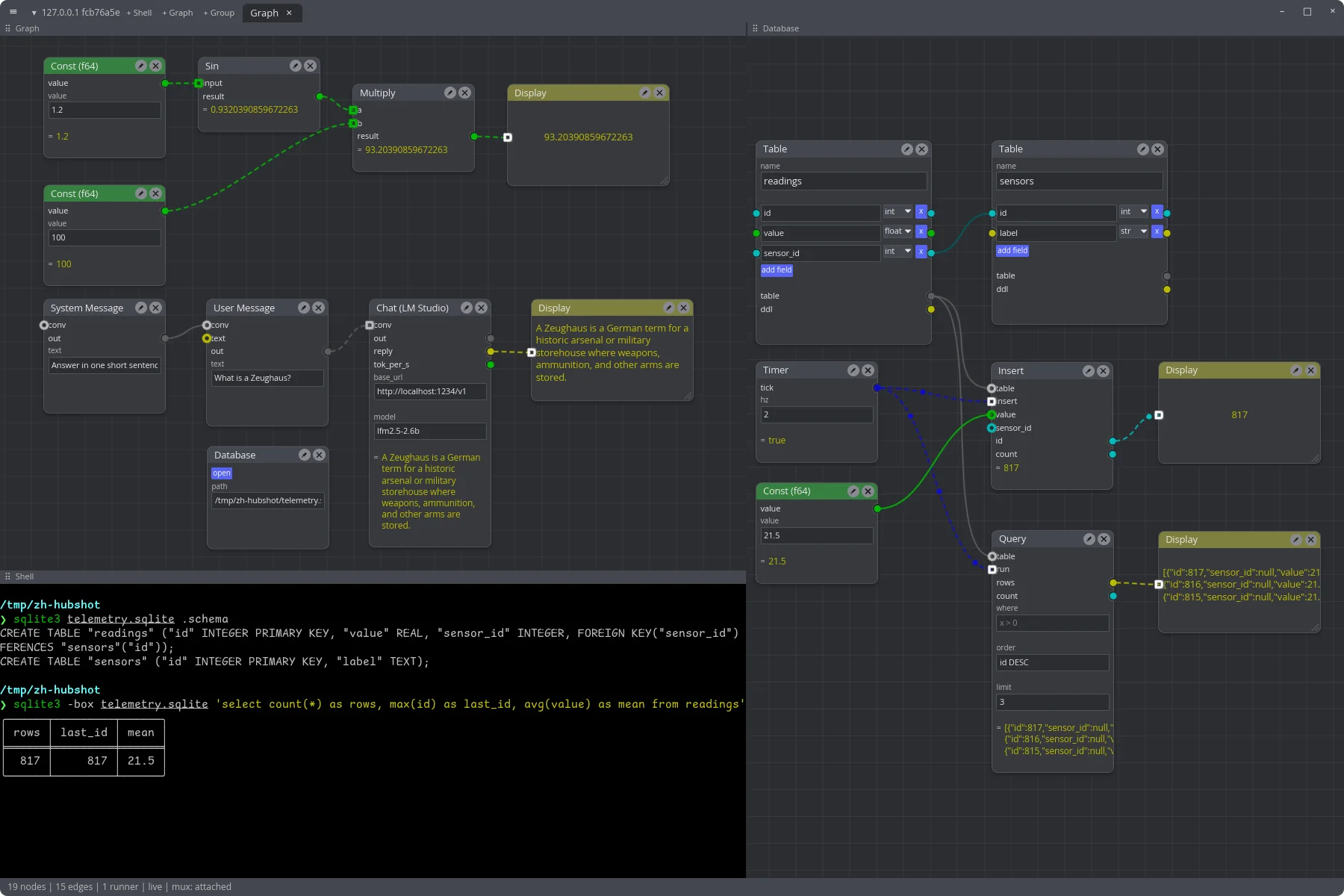
The zeughaus editor connected to a live runner: a transform chain (Const, Sin, Multiply, Display), an LLM conversation answering 'What is a Zeughaus?', a SQLite database drawn as two linked Table nodes with a Timer driving Insert and Query nodes, and a terminal pane where sqlite3 reads back the schema and the 817 rows the graph wrote.
Fig. 3 zeughaus editor, headless capture @ 3d22f00

State

  • built: Collaborative editing, live values, video feeds, subgraphs, drawn database schemas, Keras export, recordings and terminal panes
  • partial: The browser build edits locally; it does not sync with the store yet
  • pending: Routing between runners over the weida broker

Log

  1. What this log is

    Three Rust projects, all written together with coding agents, and a log of how that work actually goes.

    agents